The Ultimate Free Gaudí Architecture Walk in Barcelona: Eixample Beyond the Ticket Lines

If you stroll down Passeig de Gràcia during peak travel season, you will witness a very specific phenomenon: thousands of travelers standing on the sidewalk, craning their necks, and staring intensely at the undulating, colorful facades of Antoni Gaudí’s masterpieces.
Then, they look down at their phones, see the interior ticket prices—often clearing €35 to €45 per person—and face a dilemma. Do you blow your entire daily budget to stand in a slow-moving line inside a crowded building, or do you skip it entirely and miss out on the architectural genius that defines Barcelona?
Here is the ultimate insider secret: Antoni Gaudí designed his architecture to be a public, sensory experience. While the interiors are stunning, the true revolutionary genius of his work is entirely plastered across the exteriors. You can experience a world-class Gaudí architecture tour in the Eixample district completely for free. You just need to know how to decode the stones, the ironwork, and the hidden rivalries written into the facades.
1. The Block of Discord (Illa de la Discòrdia)
Your self-guided walk begins on Passeig de Gràcia, between Carrer de Consell de Cent and Carrer d'Aragó. This single city block is the ultimate introduction to Barcelona's competitive Modernisme era. In the early 1900s, Barcelona's ultra-wealthy elite hired competing superstar architects to build the flashiest mansion on the street.
[ Casa Lleó Morera ] ───> [ Casa Amatller ] ───> [ Casa Batlló ]
  (Domènech i Montaner)       (Puig i Cadafalch)       (Antoni Gaudí)
Because the styles clashed so violently, locals dubbed it the Block of Discord. While most tourists crowd right in front of Gaudí's building, step back to see the architectural battle play out.
The Secrets of the Casa Batlló Exterior
Gaudí took a boring, conservative apartment building and radically transformed it for the textile tycoon Josep Batlló. The local nickname for this building is Casa dels ossos (House of Bones), and one look at the facade tells you why.
- The Balconies: Look closely at the lower balconies. They aren't just decorative ironwork; they are shaped exactly like the facial bones of a skull or theatrical masks. The stone pillars supporting the large first-floor windows resemble human leg and arm bones.
- The Legend on the Roof: Look up at the very top of the building. The roof is arched and covered in shimmering, iridescent green and blue ceramic tiles. This isn't an abstract shape—it represents the scaled spine of a massive dragon. The small, cross-topped tower piercing the roof represents the sword of Saint George (Sant Jordi, the patron saint of Catalonia) plunged deep into the beast's back.
2. La Pedrera (Casa Milà): The Mountain That Woke Up the City
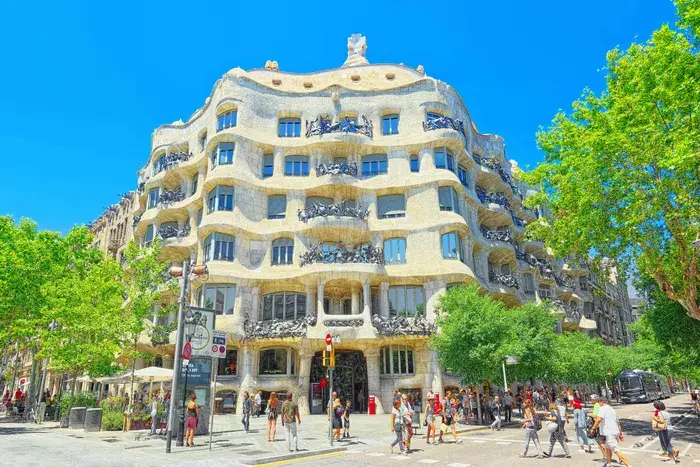
Walk three blocks up Passeig de Gràcia to the corner of Carrer de Provença. Here sits Gaudí’s last civil work before he dedicated his entire life to the Sagrada Família: Casa Milà.
When it was unveiled in 1912, the public absolutely hated it. The heavy, undulating grey limestone facade looked so raw and bizarre compared to the elegant, classical mansions nearby that newspapers published satirical cartoons mocking it. Locals mockingly called it La Pedrera (The Quarry)—a nickname that stuck and is now its official title.
What to Look for from the Sidewalk:
- The Wavy Wall: Gaudí completely abandoned straight lines. The entire exterior is a load-bearing structure of curved stone, designed to mimic the natural swells of the nearby Montserrat mountain range or natural ocean waves.
- The Forged Iron Balconies: Do not skip a close look at the balconies. Gaudí didn't draw blueprints for them; he let local ironsmiths twist scrap iron sheets, bars, and chains intuitively. Each of the 32 balconies is a completely unique piece of abstract art, resembling tangled seaweed washed up on a stone cliff.
- The Roof Sentinels: If you stand across the street and look up at the roofline, you can catch glimpses of bizarre, stone figures peering back down at you. These are functional chimneys and ventilation shafts disguised as mystical, helmeted guardians. (Fun fact: George Lucas visited this roof and used these exact chimneys as the visual inspiration for the Star Wars Stormtrooper helmets).
3. The Hidden Catalyst: Casa Vicens
To truly outsmart the tourist crowds and round out your architectural masterclass, take a 15-minute walk up into the quiet, bohemian neighborhood of Gràcia to find Casa Vicens (located on Carrer de les Carolines).
Because it sits tucked away in a residential neighborhood away from the main boulevard of Passeig de Gràcia, it gets a fraction of the footfall. Yet, this is where the Gaudí phenomenon officially began. Built between 1883 and 1885 as a summer holiday home for a wealthy broker, this was Gaudí’s very first major residential commission.
The Exterior Highlights:
- The Neo-Mudéjar Vibe: Unlike the organic, skeletal shapes of his later works, Casa Vicens is an explosion of straight lines, sharp geometric angles, and vibrant, oriental-inspired patterns influenced by Moorish design.
- The Tile Story: The exterior is covered in bright green and white ceramic tiles interspersed with yellow marigolds. According to local history, when Gaudí visited the empty site before building, he found a field completely filled with these exact yellow flowers. He chose to immortalize them forever in the clay tiles of the house.
The Independent Explorer's Checklist
| Strategy | Why It Matters |
|---|---|
| Walk the Shade Side First | Passeig de Gràcia is wide. Walk on the opposite side of the street first to appreciate the full scale and rooftops of the buildings before crossing over for close-up details. |
| Look for the Textures | Gaudí relied heavily on trencadís—a mosaic style made from broken pieces of tile and glass. The colors shift dramatically depending on the angle of the sun. |
| Time it for Golden Hour | The late afternoon sun hits the glass mosaics of Casa Batlló perfectly, making the dragon roof look like it is actively glowing. |
Experience Barcelona with Voiceroam
Don't spend your journey staring down at a blog post or wrestling with rigid tour schedules. Voiceroam transforms static city streets into deeply immersive audio documentaries triggered automatically by smart GPS.